Salesforce – Part one
An untitled invitation from Stewart appeared on my calendar one morning in the late fall of 2020. Though we met more or less frequently for ongoing product work with the team, it was unusual to get an invitation from him directly.
I opened it and found the attendee list, my eyebrows rising. The other invitees were Cal, Serguei, Myles, Ali and Eric. Eric retired from Slack in 2016. The rest of us had been there from the beginning. Brady left after going public, so we were what was left of the original eight.
What was Stewart up to? I immediately switched to my group chat with Myles and Ali. Like the layers of an onion, we also had a group DM with the founders, but I wanted to gossip with my fellow non-founders first.
“Is Stewart leaving?” I guessed.
“I have no idea,” Ali responded, exhibiting her typical unwillingness to speculate without first getting more information. “I would if I was him,” Myles said, exhibiting his typical plainspoken pragmatism. After 8 years of working together we didn’t need to say much.
We had been a public company for over a year. The business was growing and the company had managed the unplanned transition to remote work fairly smoothly. But the pandemic had been going on for eight months, with no hope of it ending any time soon. The stock market was cycling through waves of pessimism and uncertainty. Our stock, minted at $38.50 in June 2019, was wallowing in the low $20s. There was a lot of pressure to get back to our listing price.
I reasoned that our CEO might be ready to step back, given his complete and total focus on Slack for the last eight years. Eleven if you counted Glitch. I had seen up close that Stewart was absorbing every ounce of his capacity into the company. Who wouldn’t want a break from such a demanding, high-visibility role?
The meeting arrived. Everyone popped into their little squares on Zoom over a couple of minutes. Cal and Stewart from their well-lit media-ready home offices with professional cameras. Serguei and Ali and Myles and I from our webcams. Eric arrived with his warm smile, enthusiastic to see us after so long. We made a little small talk. Though we all knew each other well, the fatigue and wear of the pandemic was plain on everyone’s faces. The question of the meeting’s purpose undercut any genuine conversation.
Stewart got around to it quickly. “Right now our stock is around $22. What would you say if we sold the company to Salesforce at $45 a share?” This was met by a long moment of silence. Surprise on most faces. Cal already knew. I put my hands over my face and processed the information. This possibility had never crossed my mind.
After a beat, there was a flurry of follow-up questions. Who knows? Why? When? And why? Is it already settled? What does Salesforce do? Also why?! The rest of the company would be notified later that week and the market and press shortly afterward. We were in a lockup period for share sales before earnings, so there was no risk of employees trading on the information.
“We had recently been discussing that no one would ever buy us before the offer came,” Cal later said. “We didn’t think anyone had the money for it, or that those who did like Google wouldn’t be interested.”
So why did Salesforce want Slack?

Benioff’s company
Marc Benioff is the larger than life co-founder of Salesforce. He founded the company alongside Parker Harris in 1999 and had grown it into a hugely successful business in the two decades since.
Benioff was early to recognize that business software would move to the internet. “The Cloud” was a new concept at the time. Most of the hype in 1999 was focused on the dot-com boom of consumer websites that would reshape commerce and retail. Benioff focused on building enterprise tools instead, leapfrogging Oracle and other players in the market to gain a valuable early foothold online. He honed in on tools for salespeople, a market segment that will eagerly spend money on software if it improves their success rate.
Hosting Salesforce software online eliminated the need for customers to buy and maintain complex on-premise hardware, which was a major expense at the time. The business grew rapidly, riding the waves of broad adoption of the internet and catalyzing the trend toward the software-as-a-service business model.
Salesforce invested heavily in branding and marketing from the beginning. A friendly blue cloud backs their logo, suggesting ease and lightness. They host a massive annual user conference called Dreamforce in downtown San Francisco, attracting tens of thousands of developers and salespeople with free performances from musical acts like Metallica and the Foo Fighters. Celebrities like Matthew McConaughey and will.i.am represent the company in ads and at events, presumably happy to lend their fame in exchange for cash and equity.
The company is home to a family of animated mascots that give an aura of cuddly sweetness to the dull reality of business software. The entry to Salesforce Tower, San Francisco’s tallest building, is festooned with these mascots and the imagined green acres they inhabit. They sell them as stuffed animals.
Benioff claims to have been inspired to start the company while swimming with a pod of dolphins. One can only try to imagine the vision of an internet-based Customer Relationship Management database that swam before his eyes, backed by the squeaking chorus of playful cetaceans on a Hawaiian beach.
By 2020, Salesforce was consistently one of the top 10 software companies in the world by market cap. Their CRM tool had an enormous amount of lock-in for customers, who invested not only their money into the platform but also their essential business data and workflows. Switching costs away from the platform were forbiddingly high. The revenue this generated for the company grew inevitably year-on-year. Salesforce’s position was strong and its fundamental business model was durable.
This gave Salesforce the cash to purchase other companies. They bought Quip in 2016 for $750M, MuleSoft in 2018 for $6.5B, and Tableau in 2019 for $15.7B, among many others. These acquisitions gave them a broader range of offerings that they could bundle with the core CRM tool, and additional revenue streams to grow their treasure chest.
Despite this position of business strength and their heavy emphasis on marketing, Salesforce occupies a funny place in tech. It is not a household name like Google, Amazon and Apple. They don’t sell consumer products. Even for those in the industry it’s hard to say exactly what the company makes or why people buy it. They make software, and charge ongoing premiums to integrate that software into the rest of their customers’ business tools. Household name or not, business was definitely good.
All this made Marc Benioff a billionaire. He used his wealth and influence to purchase Time magazine and participate vocally in San Francisco politics. He inserted himself into progressive causes at various times, calling for better funding to fight homelessness in the city and advocating for LGBTQ+ rights. He and his wife Lynne donated extensively to philanthropic efforts on an ongoing basis. Over time he would shift his political affiliation as the winds changed from the Obama years toward figures like Trump and Musk.
The offer
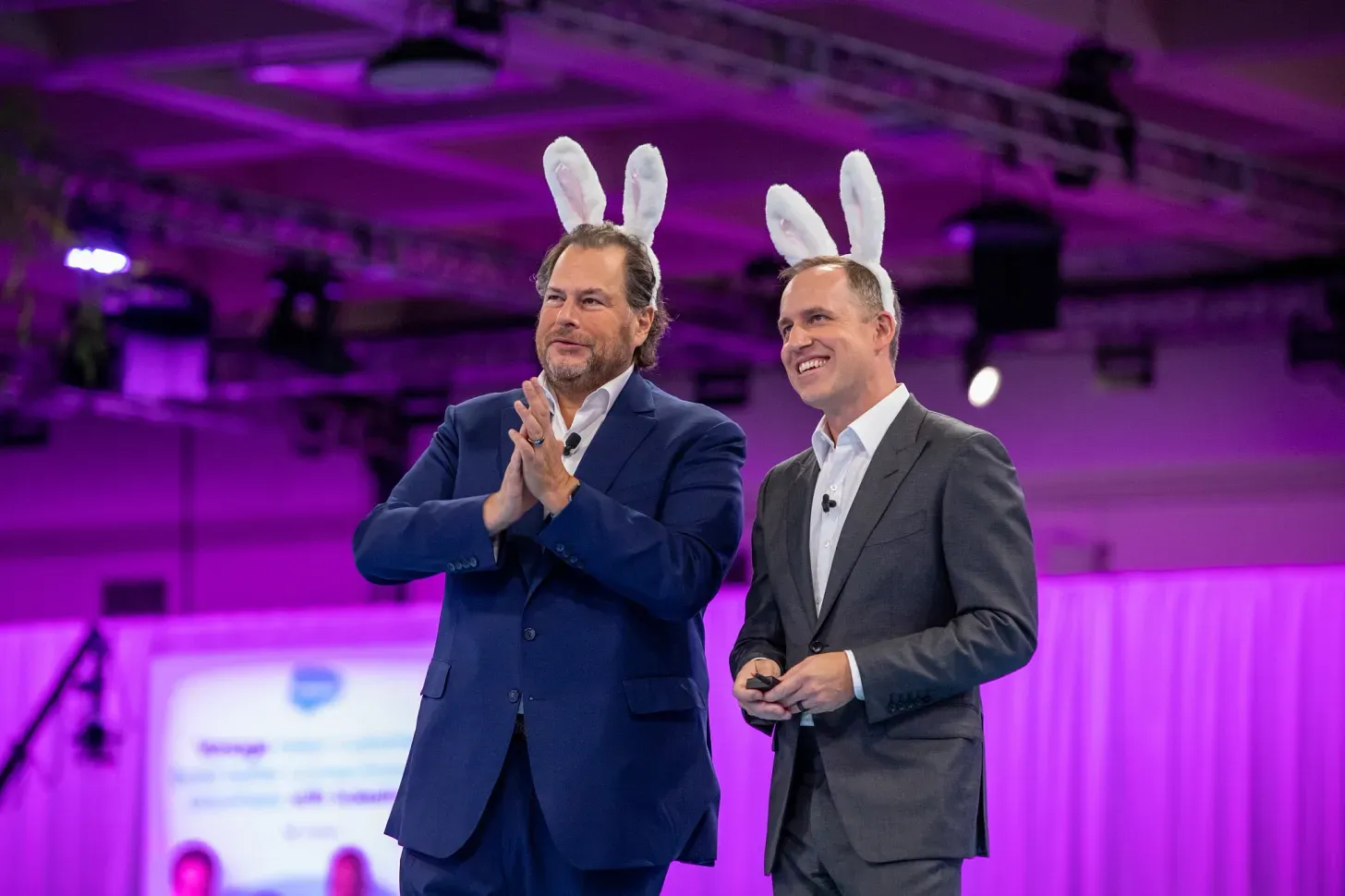
Bret Taylor was Salesforce’s Chief Operating Officer in 2020. Bret was well-known in tech for his range of successes as one of the creators of Google Maps, CTO of Facebook from 2010-2012, and founder of Quip, a document-editing tool.
He joined Salesforce in 2016 when the company bought Quip, leveraging that event into an executive role for himself at the company, eventually rising to share the CEO role with Benioff. Taylor had a reputation for business acumen, product sense, and engineering depth. His resume demonstrated his ambition to be a force in silicon valley. In 2020, Taylor was leading Salesforce’s daily operations as COO. Benioff was focused on vision and customers and was less involved in the day to day.
At one point before Slack went public, Stewart approached Bret to suggest he sell Quip to Slack. Our built-in document editor was straightforward and sparsely used. It did not have the breadth of features or robustness to act as a true document editing suite for a customer. Instead it was a light companion tool for longer posts in channels. Stewart wondered if we might buy and integrate Quip since it was already tailored for the enterprise market. The discussions didn’t get very far, and nothing came of it.
To Stewart’s surprise, Bret reached out in the late summer of 2020 with a counter-proposal. What if Salesforce bought Slack?
The pandemic had suddenly forced every company to become a remote company. There were two tools every one of those companies needed: video calls and team communication. Zoom, which went public in 2019, was perfectly positioned to capture a huge portion of the video calling market as millions of office workers switched meetings to video conferences. Slack and Microsoft Teams were the team communication tools that everyone was reaching for. Taylor saw how the pandemic had accelerated adoption of these tools, and that Slack was rapidly becoming the digital headquarters for hundreds of thousands of companies. He liked what he saw.
At the time, Slack was approaching $1B in annual recurring revenue. This was a major milestone that, at least internally, felt like it would cement our position in the market. We employed roughly 4,000 people and had over 140,000 customer companies around the world.
That same quarter Salesforce crossed $20B in annual revenue. They employed over 50,000 people and had tens of thousands of enterprise customers. We were a fraction of their size, but represented a valuable slice of the market. Slack sold into the “best of breed” companies in the Fortune 500, and had a market position aligned with market leaders in the creative, news, and software industries. The potential for combining Slack’s customer base with Salesforce’s was a tantalizing prospect.
Additionally, Slack was a natural frontend to expose Salesforce’s suite of products to end users. Salesforce records could be shared and discussed in channels. Workflows could be triggered, monitored, and completed without ever leaving Slack. And Slack had the consumer awareness and customer love that Salesforce valued.
The purchase price Salesforce offered was mind-boggling. At the proposed $45 per share, the deal valued Slack at $27.7 billion dollars. If it went through, the acquisition would be second in size only to IBM’s purchase of Red Hat in software history, which sold for $34B in 2019. In an industry of wild financial superlatives, this one was truly stunning.
Stewart told me that, “We considered what options we had, and discussed alternatives amongst the exec team, but it became clear pretty quickly that we would take the deal.” If Stewart wanted to reject it, he would need to plausibly argue to the board and shareholders that he had a path to meet and surpass the value of the deal on offer, and quickly. The offer that set the price at 28x our annual revenue and more than double our stock price. The same stock that had been on a downward trend since we went public.
As Cal put it when we interviewed him:
Once that starts becoming a serious discussion, then it follows a process. And you have a responsibility to your shareholders as well, because we were a public company and they were offering a lot of money for us. And so then it became a whole process and once those wheels start turning, they don't stop turning.
Sharing the news
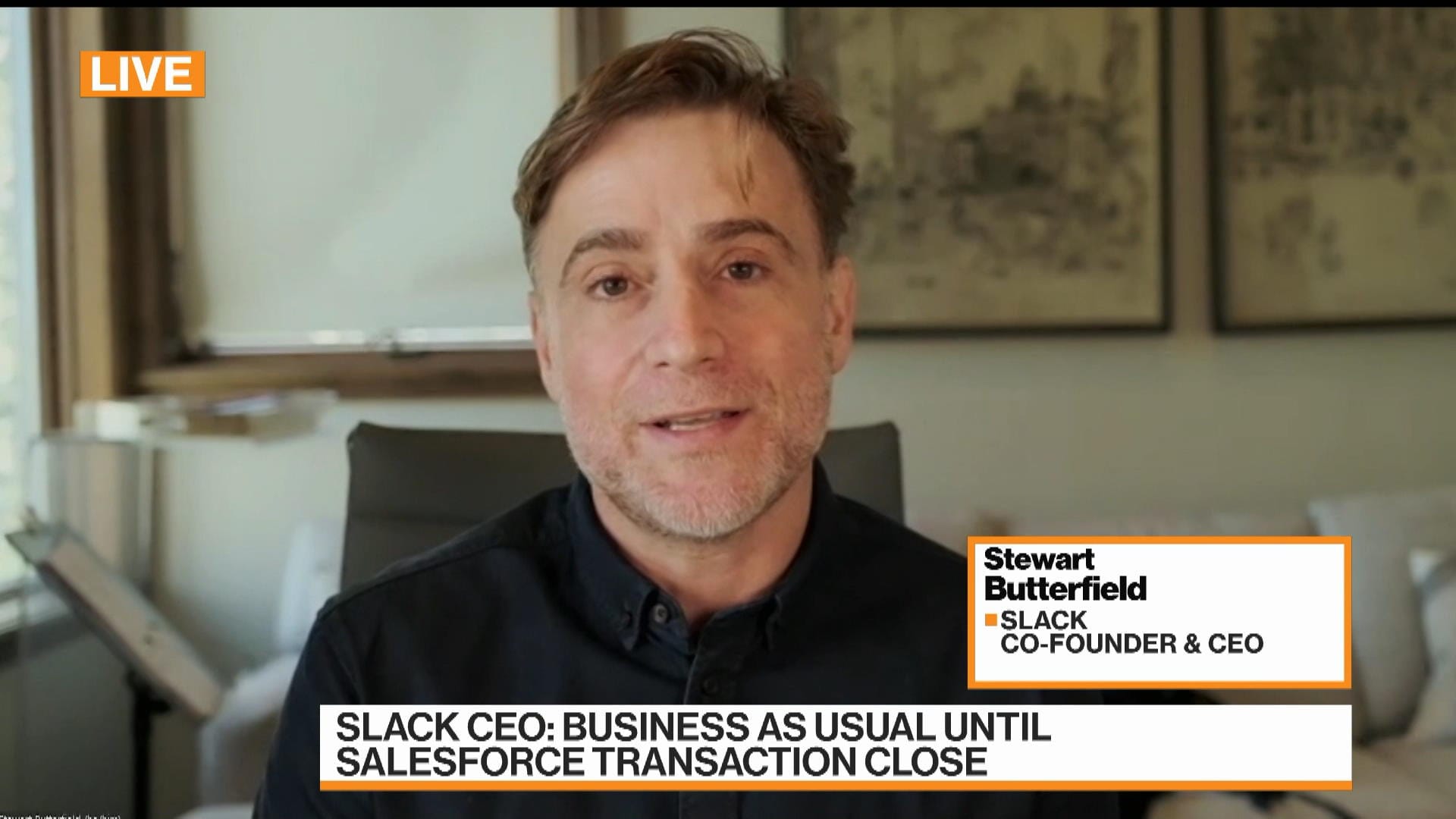
The news of the acquisition was shared with the company in November at our monthly All Hands meeting. The reaction ran the gamut. Surprise and excitement about the jump in our company’s value. Confusion about Salesforce as the buyer, which had never been rumoured or discussed internally. Disappointment that we would lose our independence. Anxiety from those veterans that knew acquisitions also likely meant job losses for certain roles. Shrugs of acceptance from many who knew this was the way things went in our industry.
Privately many of us expressed disillusionment. Part of the premise of our growth and race to go public was that we would outgrow acquisition interest and stand on our own two feet. We loved the company we had created and felt fierce ownership over it. What would Salesforce and one of tech’s powerful billionaires do to our company? What would it do to our product? What would it do to us?
At the same time, for everyone who held equity (which was almost everyone), our stock price had more than doubled. The financial impact and freedom this would bring to employees at the company was significant. For many, the listing day price of $38.50-$42 had remained as their anchor on what the price “should be.” As irrational as that assessment was, it guided many to hold their equity through the dips since that initial high. Now that patience was paying off.
Stewart laid out the conviction he had that the combination of Salesforce and Slack could result in a “1+1=7” type of outcome, where our overlapping strengths and potential new possibilities for the product became a force multiplier on what we could achieve. This could put us on a path to 100M users. He spoke highly of Bret Taylor’s leadership and of his understanding of Slack’s unique value.
On December 1st, a carefully coordinated rollout of information was released simultaneously by Slack and Salesforce, and shared on our earnings call. Slack’s stock price immediately began converging to the deal price of $45/share. Salesforce’s stock price dipped several percentage points as investors grappled with the scale of the acquisition.
We entered a period of limbo until the deal could be approved by federal regulators. Once that arrived, we would officially join Salesforce. Slack would cease to be an independent company.
Thank you to Stewart and Cal for their notes on this post.